How to Not Cry During a Wedding Speech (Or At Least Recover When You Do)
Crying mid-speech is more common than you think. Here's what actually helps before and during, and how to recover gracefully when it happens anyway.
Part of the How to Write a Wedding Speech guide: structure, length, opening lines, and delivery.
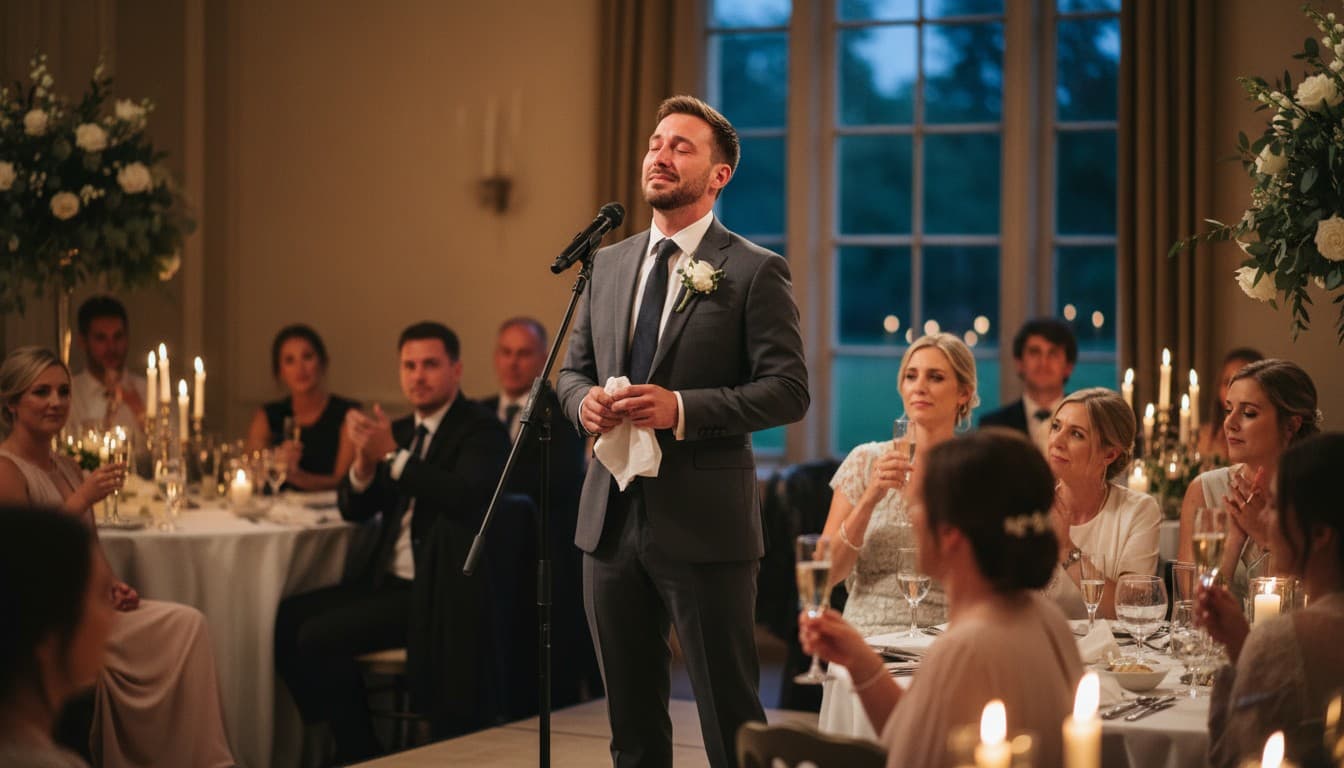
Some people cry. Some people go in completely sure they won't cry and then cry at a line they've read forty times before. A very small number of people cry so hard they can't finish, and even then, the room is pulling for them the entire time.
Nobody has died of embarrassment from crying at a wedding speech. The room is full of people who are already emotional. They are at a wedding. They came here to feel something.
The real concern isn't the crying itself. It's losing control of the speech when it happens: stopping cold, losing your place, not being able to get back. That's the thing worth preparing for.
Why it happens when it happens
You've been carrying this speech around in your head for weeks. You've thought about these people, rehearsed this material, sat with it in quiet moments. By the time you're standing at the microphone, you've lived inside this thing so long it feels ordinary.
Then the room goes quiet. You see the couple's faces. The full weight of what you're about to say lands all at once, and the emotional wall you've been maintaining gives out.
It's not weakness. It's what happens when something matters and the moment finally arrives to say it. The people who cry in the middle of wedding speeches are, almost without exception, the people whose speeches mean the most. That's the trade.
The goal isn't to eliminate that response. It's to not be surprised by it, and to know what to do when it shows up.
What actually helps before the day
The single most useful thing you can do is cry before you get there.
Run the speech out loud, start to finish, enough times that you hit the emotional parts before the wedding. Not in your head. Out loud, at pace, the way you'll actually deliver it. When the line that's going to get you shows up in rehearsal, let it get you. Cry in your kitchen. Get through it anyway. Do it again.
Crying in rehearsal is just crying in rehearsal. There's nothing at stake. It gets the response out of your system and, more usefully, it teaches your body what comes after that moment: that the speech continues, that you get through it, that it's survivable.
By the time you've hit that line six or seven times in practice, you've built something like familiarity with it. The moment still carries weight. It just doesn't catch you off guard the same way.

One thing that sounds strange but works: look just above the audience's heads, rather than directly at the couple, when you're delivering the lines you know are going to hit you hardest. Not for the whole speech. Eye contact matters and the couple wants to feel you speaking to them. But for the specific moments where you know you're vulnerable, looking at the back wall rather than at someone's face takes some of the immediate emotional charge out of it.
Looking directly at the person you're saying something profound to while you say it is what breaks people. There's a reason performers talk about "playing to the back of the house." It's a real technique.
Build a pause into your speech right after the line that will get you. Not an accidental pause, an intentional one. When you're writing or rehearsing, think: this is the line where I slow down, look at my notes for a moment, take a breath, and then continue. Make it part of the speech rather than an interruption of it.
The pause is not evidence that you're falling apart. A two-second pause reads as weight and intention. It tells the room that what you just said mattered. It almost always lands as a better choice than pushing straight through.
Keep water nearby. Not because water cures crying. It doesn't. Because the thing that comes just before crying, or alongside it, is a tightening in the throat that makes words harder to form. A sip of water doesn't fix the emotion, but it gives your throat a moment and gives you something to do with your hands while you collect yourself.
What doesn't help
Trying to push the feeling down completely tends to backfire. You're putting pressure on something that wants to release, and when it does come out it comes out harder. People who white-knuckle their way through emotional speeches often end up breaking at the exact wrong moment because they held on too long.
Telling yourself you won't cry creates a setup for failure. Now you have two things to manage: the speech and the internal commentary about how you're doing. That's too much.
Drinking before the speech is a common idea and a consistently bad one. A drink might make you feel more relaxed for a few minutes, but it lowers your control, and control, specifically the ability to pause and recover, is what you actually need. Have the drink after. You've earned it.
When you're already crying mid-speech
Stop. That's step one. Not barrel through, not apologize, not make a self-deprecating remark yet. Just stop.
Take a breath. A full one. Let three or four seconds pass. Look down at your notes if you need to find your place. Then look back up.
Three seconds feels like thirty to you. It doesn't to the room. The room will wait, and they are rooting for you while they wait.
If you need to acknowledge it, "okay, give me a second," that's completely fine. It's human, and it usually breaks the tension in the best possible way. The room laughs softly, the pressure drops, and you continue. A moment like that is often the one people mention afterward.
What you don't want to do is apologize repeatedly or make the moment about how embarrassed you are. That makes the room uncomfortable because they're now managing your discomfort rather than just being with you. Say it once if you need to say it, then move on.
A note for parents in particular
If you're a parent of the couple, there are lines in your speech that will get you. You probably already know which ones. The lines about letting go. About watching them grow up. About what this day means in the long arc of being their parent.
Don't try to rewrite those lines to make them safer. That would make the speech worse. Know they're coming and make peace with them in advance. Rehearse them until you've cried at them enough times that you can get through them and keep going.
Your son or daughter is watching you say something you've never said out loud before. The emotion in the room when a parent struggles through one of those lines, gets it out anyway, and finishes the speech, that's not a problem. That's the speech working exactly as it should.
The thing to hold onto
The speeches people remember are the ones that meant something. Not the ones that were perfectly polished or delivered without a single crack in the voice. The ones where it was obvious the person saying it actually felt it.
Crying is evidence your speech is working. It means the weight of what you're saying is visible, and that's the whole point of standing up and saying it.
Practice until you can get through it. Know where the hard moments are. Have the pause ready. And if you still cry in the middle of it, good. Keep going.
Keep reading:
- Terrified to Give a Wedding Speech? Read This First
- How to Practice Your Wedding Speech
- How to Memorize a Wedding Speech
If the anxiety is coming from the speech itself, from not knowing what to say or whether what you've written is actually right, that's the part you can solve before the day comes. SpokenVow interviews you the way a speechwriter would and builds a full draft around your stories and voice.