Terrified to Give a Wedding Speech? Read This First
Wedding speech anxiety is completely normal. Here's what actually helps, and why the thing you're most worried about probably won't happen.
Part of the How to Write a Wedding Speech guide: structure, length, opening lines, and delivery.
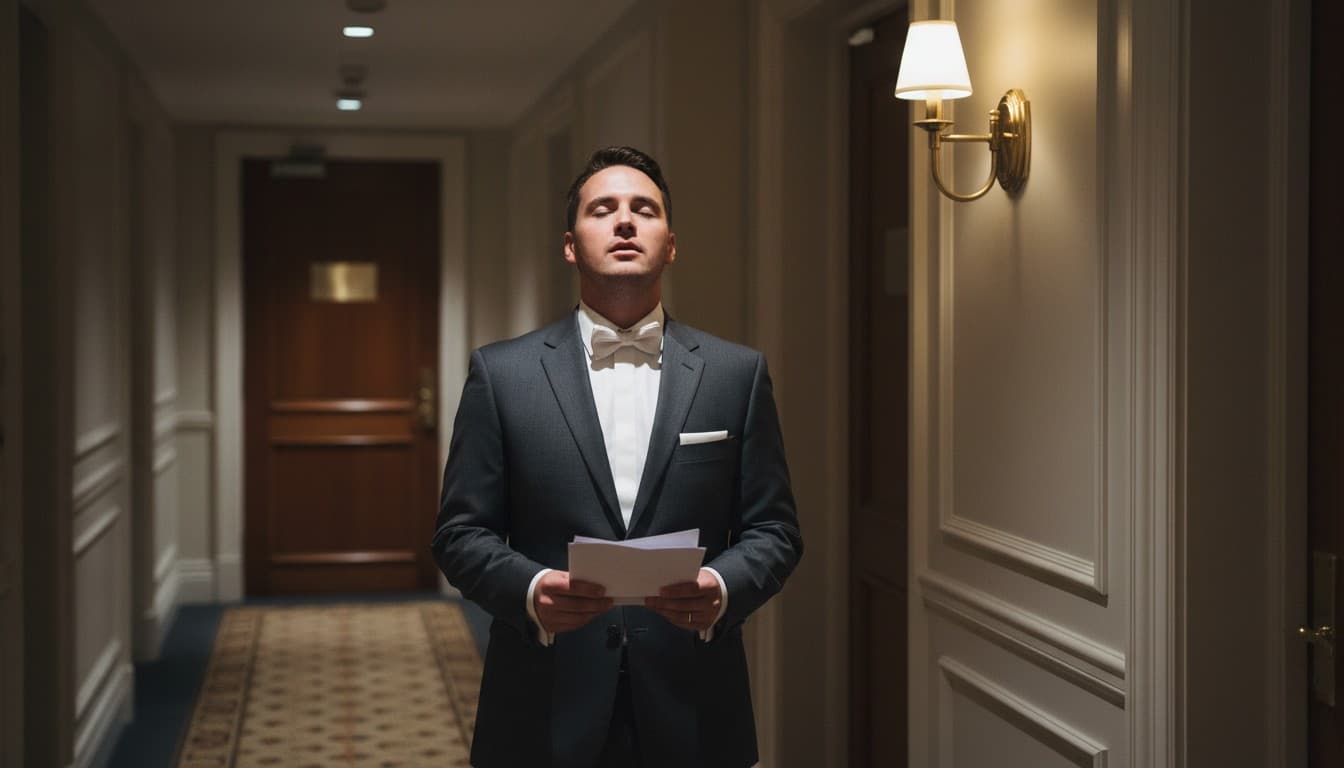
It's 3am, four days before the wedding. You're lying there reading your speech on your phone for the ninth time, and you've convinced yourself it's terrible. Not just bad. Actively terrible. The jokes aren't funny, the story in the middle goes too long, and the ending sounds like a greeting card that lost its way.
You're not asleep because your brain is running a very specific simulation: standing at the microphone, going completely blank, the entire room watching you, and nothing coming out.
Here's the thing. That 3am version of yourself is not a reliable narrator. The speech is probably fine. And almost every specific fear you're carrying right now has a practical answer that is much less dramatic than what your brain is currently proposing.
Let's go through them.
"I'm going to blank out completely"
This is the most common fear and, statistically, the rarest outcome. Full blanking, where you stand there and nothing comes, almost never happens to people who have actually practiced. It happens to people who tried to memorize the speech word for word and then lost the thread. It does not happen to people holding a piece of paper.
Bring printed notes. Refer to them freely.
Not a phone. A printed page, or index cards, held in your hand. People expect speakers at weddings to have notes. Nobody thinks less of you for glancing down. What they would think less of is you standing there in silence because you refused to bring a backup.
The note is not a crutch. It is a net. Having it means your brain stops allocating anxious energy to "what if I forget" and starts being present in the room.
Practice it enough times that you know the shape of each section. Know what you're trying to say, not every word you're going to say. If you lose your place, a quick glance at your notes gets you back in three seconds. The room will wait.
"I'm going to say something wrong"
There's one rule that solves this entirely: nothing in the speech that the couple hasn't already approved.
If you're considering a story about something embarrassing, a reference to an ex, anything that could land sideways, run it by them first. Not because they're censoring you. Because the last thing you want is to be standing at the microphone watching someone's face fall because you said something they weren't expecting.
Once you've had that conversation and made any cuts they asked for, this fear dissolves. You've already gotten the clearance. There's nothing left to say wrong.
The anxiety about saying the wrong thing is really anxiety about the unknown. Remove the unknown by knowing, in advance, that the speech has been approved. Then let it go.
"I'm going to cry"
You might. A lot of people do. Here is the complete guide to handling it:
Pause. Take a breath. Carry on.
That's it. That's the whole protocol.
The room is not waiting for you to fail. They are on your side completely. When someone tears up at a wedding speech, the room doesn't think "this person is unprofessional." They think "this person genuinely loves the couple." Which is the entire point.
A brief pause to collect yourself is not a disaster. It is a human moment, and human moments at weddings are usually the ones people remember.
The mistake is trying to barrel through when you're genuinely overwhelmed, speaking through a cracking voice and losing the words. If you feel it coming, slow down. Take the pause. The room will wait, and they will be rooting for you to find it again.

"I'm not funny enough"
You don't need to be.
The speeches people remember are not the ones that were the funniest. They are the ones that felt true. A single moment that the couple recognizes as real, that captures something about who they are, lands harder than five jokes that the whole room laughs at and forgets by the time dessert comes.
If you have something genuinely funny, use it. If you're trying to engineer laughs because you think a wedding speech is supposed to have them, stop. Forced humor is immediately identifiable, and a joke that doesn't land at a wedding is approximately ten times more painful than one that doesn't land anywhere else, because the room has nowhere to look.
One real laugh is better than five manufactured ones. One honest observation about the couple is better than three jokes you assembled from wedding speech articles online.
Write the speech that sounds like you talking to someone you love. The funny, if it's there, will come naturally.
"I'm going to go too long"
This one you can fix completely, today, in ten minutes.
Time it. Out loud. Set a hard limit.
Four minutes is the sweet spot for most wedding speeches. Three and a half to five is the acceptable range. Past five, you are testing the room's goodwill. Past seven, you have lost it.
The internal voice reads much faster than your actual speaking voice, so reading it in your head and thinking "that felt like four minutes" is not useful data. Say it out loud, to the wall if necessary, and time it on your phone.
If you're over five minutes, cut something. Not tighten. Cut. Find the section that is doing the least work and remove it entirely. The speech will almost always be better for it.
When you know the timing, this fear becomes a solved problem. You're not wondering if you might go long. You know exactly how long it is.
The real source of most speech anxiety
Here's something worth sitting with: most people who are terrified about giving a wedding speech are not actually afraid of public speaking. They're afraid of the writing.
They don't like the speech yet. It feels generic or uncertain or not quite right, and they're hoping the delivery will compensate. It won't. But the inverse is also true: if you actually like your speech, if you've read it enough times that it feels like yours and not like something you assembled from a template, the nerves shift. They go from dread to something closer to excitement. There's a difference between "I am scared this is going to go badly" and "I can't wait to say this out loud."
The goal of all the prep is to get to the second one.
Practice protocol that actually works
Read the speech aloud, start to finish, at least five times before the wedding. Minimum. Not in your head. Out loud, at something approximating the pace you'll use in the room.
At least one of those times should be in front of a real person. A partner, a roommate, a parent. Not for their notes, though notes are fine. For the experience of being in front of a human while you say it. Speaking while being watched is different from speaking to an empty room, and rehearsing it once before the actual thing makes the actual thing much less alien.
Record yourself once. Phone propped up, full speech, start to finish. Listen back. You will hear exactly where you're rushing, where a pause should live, and whether you sound like yourself or like someone performing a wedding speech. Those are different things.
The day itself
Eat something before you speak. It sounds like obvious advice but it isn't the advice people follow. Low blood sugar makes nerves worse.
Don't drink much before your toast. Have a drink after. The idea that a drink will settle the nerves is partially true for about three minutes and then counterproductive. You need to be sharp.
Arrive early enough to see the room before it fills. Know where you'll be standing. Know where the microphone is. That spatial familiarity reduces one category of unknown.
Find two or three faces in the room that you know will be warm, people who are already on your side before you say a word. When you're speaking, you can return to those faces. The room stops being a crowd and becomes a few people you're talking to.
Before you start, pause. Let the room come to quiet. Take one breath. Then begin. Not because the pause is necessary for you, but because it signals to yourself and to everyone watching that this is something you're choosing to do, not something happening to you.
The thing nobody tells you
Everyone in that room wants you to succeed. Not abstractly, not politely, but genuinely. They want to laugh if it's funny and feel it if it's true and raise their glasses at the end having been given something worth raising them for. The couple chose you because they believed you could do this. The guests came because they love the couple and they're predisposed toward anything that honors that.
The audience at a wedding is not a jury. They're not waiting for you to make a mistake. They're on your side before you say your first word.
Your job is to not overthink it.
Keep reading:
- How to Practice Your Wedding Speech
- How to Memorize a Wedding Speech
- How to Not Cry During a Wedding Speech
If the anxiety is coming from the speech itself, from not being sure what to say or whether what you've written is actually good, that's the part you can solve before the day comes.
SpokenVow interviews you the way a professional speechwriter would and builds three complete drafts shaped around your specific stories and voice. By the time you get to the 3am panic, you have something worth reading.