The Bride's Speech: What to Say When Nobody Expects You To
More brides are giving speeches at their own weddings. Here's what works, what doesn't, and how to write one that sounds like you.
Related: Wedding Speech Examples : real speeches across every role.
Nobody expects the bride to speak.
There's a whole built-in tradition around this. The best man speaks. The father of the bride speaks. Maybe the maid of honor. The groom, sometimes. The bride is usually the subject of the speeches, not the person giving one. She's been toasted. She doesn't toast.
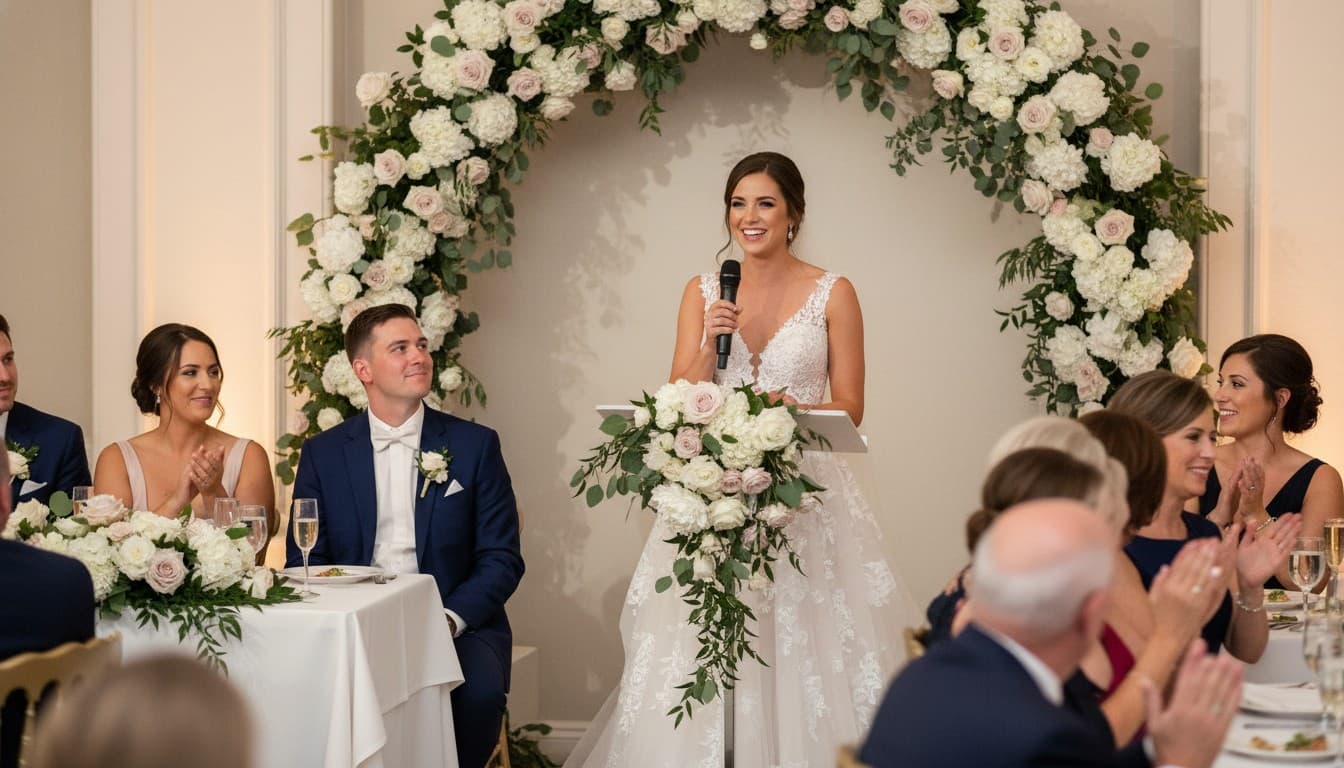
So when a bride stands up and takes the microphone, something changes in the room. People get quiet in a different way. They weren't ready, which means they're more open than they would have been if they'd been braced for it.
That's a remarkable position to speak from. You're the person everyone is already looking at. You're the one they came to celebrate. And you have something to say.
Why more brides are speaking
The short version is that the old speech format was designed around a set of assumptions that don't hold the way they once did. Dad walks the bride down the aisle, hands her to the groom, stands up later to speak on her behalf. The bride is present for all of this, but she's mostly the subject of it.
That's been shifting for years. More couples split the speech duties between both partners. More brides have things they want to say to their parents that nobody else can say. More women who are used to speaking professionally, leading teams, running things, have spent months planning their wedding and then been handed a passive role in the part where people say words.
Some brides speak because the tradition changed around them and this is just what their wedding looks like. Some speak because they have one specific thing they need to say. Some speak because they thought about it for five minutes and realized there was no actual reason not to.
All of those are fine reasons.
The different situations
A bride's speech looks different depending on where it sits in the day.
If the groom is also speaking and you're both doing it together, yours can be shorter and more focused. You don't need to cover everything. You're not the only voice. You might speak about your parents while he handles the wedding party. You might thank the vendors and guests briefly while he goes longer on the personal material. Or you each go personal and the speeches just happen to cover different territory.
If you're doing the only partner speech because the groom doesn't want to speak, or because that's what felt right for you both, you have more room. Three to four minutes. Enough to say something real about where you came from, who helped you get here, and who you're standing next to now.
If you're speaking briefly, right after the meal, to thank people while the groom handles the main toast, thirty seconds to a minute is enough. One specific thing to your parents. Your name for your new partner. Raise your glass.
The format doesn't matter as much as being intentional about which one you're doing.
What a bride's speech can do that nobody else's can
This is the part worth thinking about before you start writing.
Your parents have heard plenty of speeches about you over the years. Teachers, coaches, friends. You thanking them is different. Not because you're the bride and it's a wedding, but because you're their kid and you're doing it in public, on a day that means something to all of you. If there's a specific thing your mother did, or a particular way your father showed up for you, this is the place where saying it out loud in front of witnesses actually matters. Don't make it a list. Pick the thing.
Nobody else in that room has the same vantage point on your partner. The best man has a version of him. His parents have theirs. Yours is different. You can talk about who he is at 7am on a Tuesday. You can describe the thing he does when he doesn't know anyone's watching. You can say something true about him that wouldn't mean anything coming from anyone else but lands completely coming from you.
And you can be funny about the relationship without it becoming a roast. There are things you can say about the two of you, together, that the best man can't touch because he was only there for half of it.
What tends to go wrong
Thanking everyone by name is the most common mistake. It starts with the parents, then the wedding party, then the vendors, then the guests who came from far away, then the people who couldn't make it. By the time it's done, the speech has become a credits roll, and the room has tuned out completely. Thank your parents specifically and briefly. Gesture toward everyone else collectively. Trust that people know they're included without hearing their names.
Being too short out of nerves reads as unfinished. If you've worked up the courage to speak at your own wedding, 25 seconds leaves the room wondering if something went wrong. A minute is a minimum. A minute and a half is better. If you've got the material, three minutes is fine.
Trying to match the best man's energy is a trap. He's been workshopping jokes for months. His job is to be funny. Your job is to say something true. Different registers. The room doesn't need you to do what he did.
A structure that works
Open with something personal. Not "I wasn't sure I was going to speak today." Something that puts you in a specific moment or observation. Give the room something to hold onto in the first ten seconds.
Thank your parents. One thing each, not a summary of your childhood. Your mom for a specific thing. Your dad for a specific thing. If it's just one parent, one specific thing. If it's complicated, you can still find a sentence that's true without being dishonest about the whole picture.
Talk about your partner. Not the story of how you met (unless that story is genuinely extraordinary). Something about who they are now, something you've noticed, something the room won't hear from anyone else. One story or one observation. Don't try to capture everything.
Say something true about the marriage you're starting. Not a wish or a hope. Something you know, or something you've decided. It can be small. Small is often better.
Raise your glass.
That's it. You don't need more architecture than that.
A full example
This is 290 words. At a wedding pace, it runs just over two minutes.
I had a whole different version of this speech written. It was longer and it covered more ground and it thanked about twelve people by name. Then I read it back and realized it sounded like me trying to be thorough, not me actually saying anything.
So I cut it down to the things I actually mean.
Mom, you taught me to be a person who says what she thinks and means what she says. That sounds simple but it's not, and I know where I learned it. Thank you.
Dad, you drove four hours last October to help us move a couch that did not need four hours of driving to move. That's you. That's always been you. I love you for it.
I've spent a lot of the past year planning a wedding, which it turns out is mostly logistics. Seating charts and catering calls and a truly unreasonable number of emails about flowers. And somewhere in the middle of all of that, I'd look over at this person next to me and think: this is the reason. Not the flowers. Him.
He makes things feel manageable when they aren't. He's the first person I want to tell things to, the good stuff and the things I haven't figured out yet. He is patient in a way I genuinely do not understand and I intend to keep benefiting from it.
I'm glad everyone we love is here today. I'm glad we get to do this.
To my husband. Thank you for showing up.
The voice question
There's a version of this that goes badly when someone tries to write a bride's speech that sounds like a speech. Formal. Structured. Elevated.
The bride's speech doesn't need to sound elevated. It needs to sound like you.
If you're funny, be funny. If you're not, don't force it. If you tend toward directness, be direct. If you're emotional and that's real, let it be real. The room is already on your side in a way that no other speaker in the day gets to benefit from. You don't need a persona. You just need to say the thing.
The one thing that goes wrong in almost every bride's speech I've seen fall flat is that the person stopped trusting their own voice somewhere between the planning and the delivery. They wrote something that sounded right and then talked themselves out of it in favor of something safer or more formal or more like what a speech is supposed to sound like.
Write it the way you'd say it. Then read it out loud and see if it sounds like you.
Keep reading:
- 10 Wedding Speech Examples (And What Makes Them Work)
- How to Not Cry During a Wedding Speech
- 50 Wedding Speech Opening Lines That Actually Work
There's no wrong way to do this. The only real mistake is not saying the thing you actually meant to say.
If you want help getting it on paper, SpokenVow works the way a speechwriter would: asking you the right questions, pulling out the specific stories and details, and building something that sounds like you rather than a template.