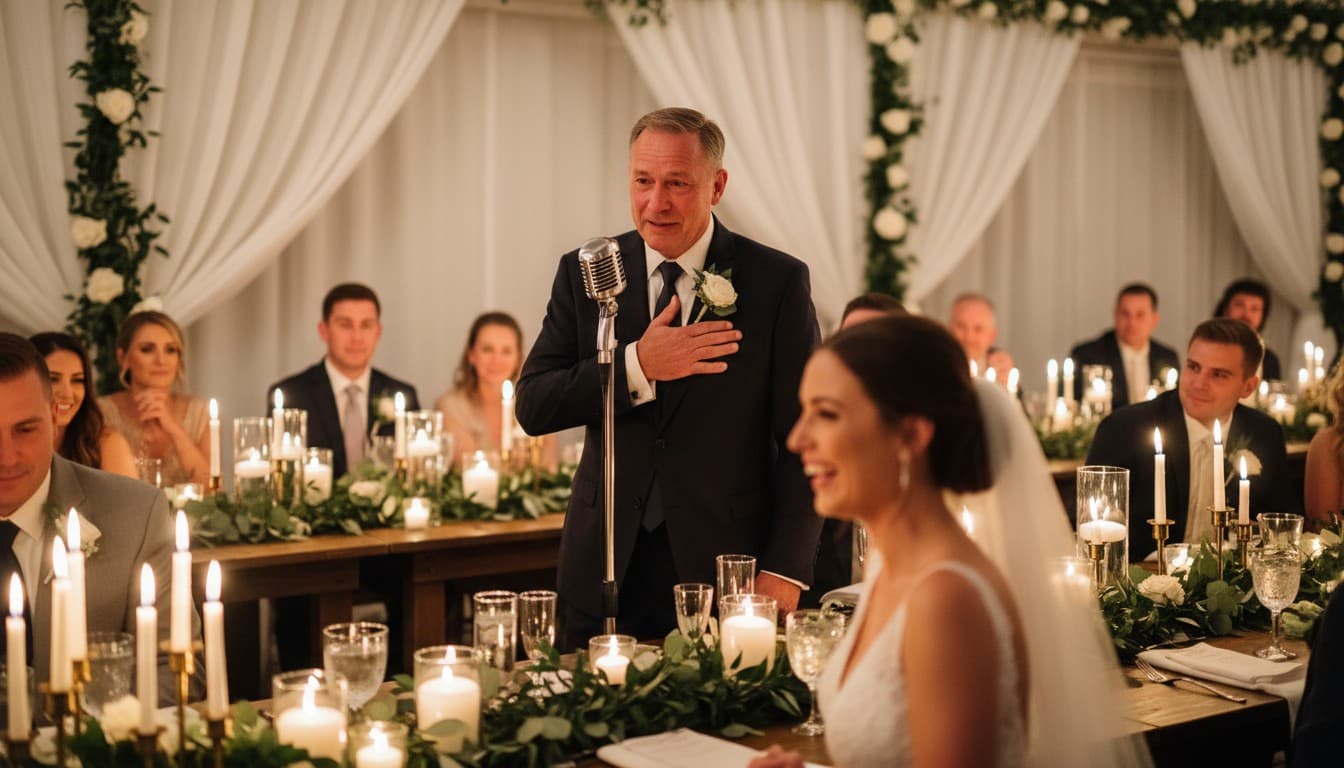
Funny Father of the Bride Speech: How to Get Laughs Without Making It Weird
Want your father of the bride speech to be funny? Here are the types of humor that work, the jokes that bomb, and 5 examples of dads who got the room laughing for the right reasons.
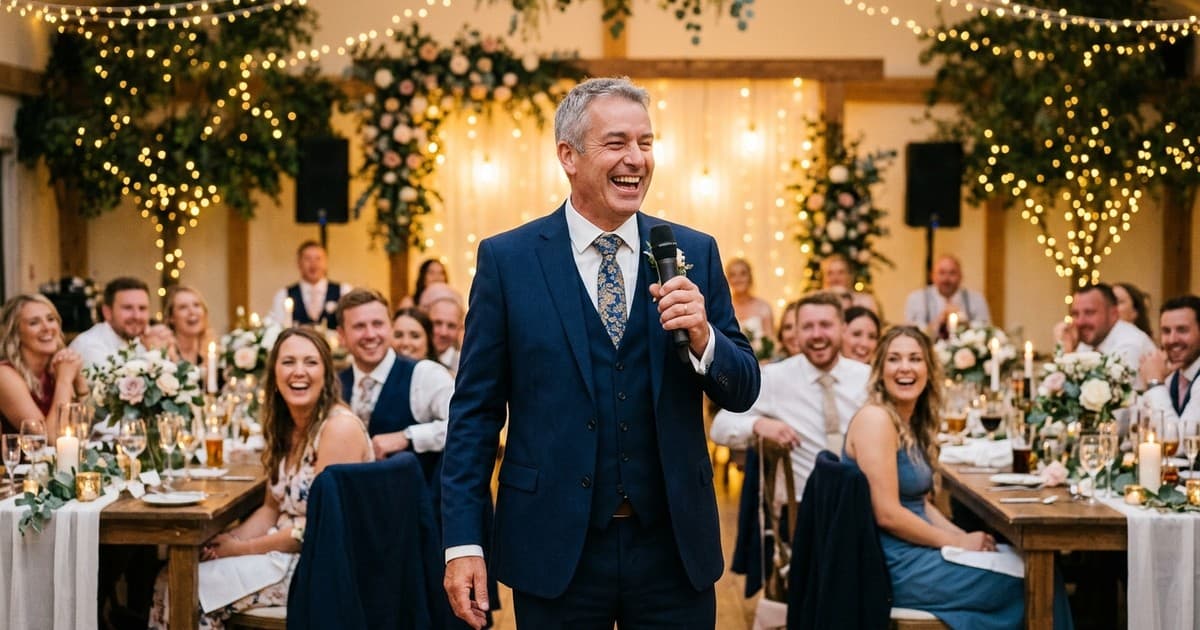
Part of the Father of the Bride Speech Guide : structure, examples, and what to say when words feel impossible.
You want to be funny. That is the first thing you decided when you found out you had to give a father of the bride speech. Not sappy. Not boring. Funny.
The second thing you decided, probably within ten seconds of the first, was that you are terrified of two outcomes: dead silence, and the moment your daughter turns to you with a look that says Dad, why would you say that in front of everyone I know.
Here is the good news. You do not need to be a comedian. You do not need to memorize a tight five. The funniest father of the bride speeches are not funny because the dad is naturally hilarious. They are funny because the dad is honest, specific, and willing to make himself the punchline. That combination works every single time, even if you have never told a joke in your life that landed on the first try.
What actually gets laughs at weddings is almost never what people expect. It is not one-liners. It is not roast material. It is the small, true observation that makes the whole room nod and then crack up because they recognize it. The audience already loves you. They already want to laugh. You just have to give them something real enough to laugh at.
Why "funny" works differently at weddings
Wedding humor is not stand-up comedy. In stand-up, you are earning the room from zero. You walk onstage cold and have about thirty seconds to prove you are worth listening to. At a wedding, you walk up to the microphone and the room is already at a seven out of ten on goodwill. They are fed. They are happy. Many of them have had champagne. They want this to go well almost as much as you do.
Your job is not to be hilarious. Your job is to not blow the goodwill you already have.
That distinction changes everything about how you approach humor. You do not need to write jokes. You need to tell the truth in a way that has a little air in it. Real stories about your daughter are funnier than anything you could invent, because the room knows her too. When you describe something true about her, half the audience is already smiling before you finish the sentence because they have seen the same thing.
The best funny father of the bride speeches share one quality: the humor comes from love, not from performance. The dad is not trying to kill. He is trying to describe his daughter accurately, and the accuracy is what makes it funny.
The 4 types of humor that actually work
Not all wedding humor is created equal. These four styles consistently land in father of the bride speeches, regardless of your comfort level on a microphone.
1. Self-deprecating (the nervous dad)
Making fun of yourself is always safe territory. You are emotional, you are old, you are out of your depth, and everyone in the room already knows it. Leaning into that is charming, not weak.
"I have been practicing this speech for six months. My wife has been practicing it for six months. We have very different versions."
Self-deprecation works because it lowers the stakes for the audience. If you are willing to laugh at yourself, they relax. And a relaxed room laughs easier.
2. Gentle character observation
This is the gold standard of funny father of bride speech examples. You describe your daughter's personality in a way that is both completely true and deeply lovable. Not embarrassing secrets. Not childhood disasters she did not approve. Just the thing about her that everyone in the room already knows.
"She has been telling me what to do since she was four. Today she is telling Marcus what to do. Marcus, welcome."
This works because it is recognition humor. The audience sees her in that description and the familiarity is what creates the laugh. You are not inventing comedy. You are pointing at something real.
3. The callback
A callback is when you set something up early in your speech and reference it again later. Even a simple callback makes the audience feel smart, and feeling smart makes people laugh.
Say you mention early on that your daughter always has a plan. Then later, when you are talking about how organized the wedding was, you pause and say: "I have no idea who planned all of this." The room fills in the joke for you. That is a callback. It does not take comedic timing. It takes a little structure.
4. The honest admission
This is the humor of saying the quiet part out loud. The thing everyone in the room is thinking but no one has said yet.
"I am not going to pretend I was immediately thrilled when she told me about the engagement. I asked three follow-up questions, googled James, and then I was thrilled."
Honest admissions land because they puncture the formality of the moment. Weddings are full of polite pretending. When someone says something plainly true, the contrast is funny all by itself.
The jokes that bomb every time
Knowing what works is helpful. Knowing what fails is essential. These categories of humor crash and burn at virtually every wedding, regardless of delivery.
Ex-boyfriend jokes. It does not matter how clever you think the line is. Bringing up an ex is awkward for the bride, awkward for the groom, and awkward for every single person at their table. There is no version of this that helps.
"Threatening the groom" humor. The shotgun-on-the-porch bit, the "I will be watching you" line, the "you better take care of her or else" posture. This was tired twenty years ago. It is dead now. It positions you as intimidating rather than loving, and it makes the groom uncomfortable at his own wedding.
Body and spending jokes. Jokes about your daughter's weight, appearance, shopping habits, or any physical trait she did not specifically invite you to riff on. These feel mean even when you do not intend them that way. And the room will side with her, not you.
Inside jokes for three people. If you have to preface a story with "okay, so this will not make sense unless you know about the time we went to..." then cut it. The ninety-seven percent of the room who were not there will check out. Inside jokes with footnotes are not jokes.
Anything that starts with "I found this joke online." The audience can tell. They could always tell. If you grabbed it from a list of father of the bride speech jokes, it will sound exactly like what it is: someone else's line in your mouth.
Five funny father of the bride speech examples
These are short excerpts, each using a different humor style. They are fictional but grounded in how real speeches sound when they work.
1. The self-deprecating opener
"For those of you who do not know me, I am Sophie's dad, and I am absolutely not going to cry during this speech. I told myself that. I told my wife that. My wife laughed. So we will see how that goes."
Why it works: The dad names the thing everyone expects, then undercuts his own confidence. The wife detail adds a second layer. It is honest, warm, and immediately puts the room at ease.
2. The character observation
"Rachel has always been the most organized person in any room she walks into. When she was eleven, she made a spreadsheet to rank her birthday party venues. She interviewed three of them. She was eleven. So when she told me she had found the person she wanted to spend her life with, I knew that decision had been researched, vetted, and cross-referenced. And honestly, that is the most comforting thing a father can hear."
Why it works: It paints a specific, loving portrait of who Rachel is. The humor is not at her expense. It is in the recognition. Anyone who knows her is already nodding.
3. The honest reaction to the engagement
"When Tom called me to ask for my blessing, I did what any reasonable father would do. I said yes immediately, then hung up and called my wife to ask if I was supposed to say yes immediately. She said I was. So, Tom, if it felt too easy, just know there was a whole second phone call you did not hear."
Why it works: It shows the dad's vulnerability without being heavy about it. The structure (apparent ease, hidden panic, wife as the real decision-maker) is universally relatable.
4. The groom welcome
"I want to say something to Daniel. Over the past two years, you have shown up to every family dinner, fixed the thing in the garage I have been pretending is not broken, and listened to my opinions about football without once pointing out that I have been wrong about every prediction since 2019. You are a better man than most, and I am very glad you are joining this family. Also, the thing in the garage is broken again."
Why it works: The compliment is real and specific. The light sting at the end (the broken thing in the garage) is affectionate, not aggressive. It welcomes the groom without threatening him.
5. The emotional pivot
"People keep asking me how I feel about all of this. And the honest answer is, I feel like I am losing my best project manager. She scheduled my dentist appointments until she was twenty-three. I have not been to the dentist since. But when I watch her with Alex, I see someone who found a person worth reorganizing her whole life around. And that is not a loss. That is the entire point."
Why it works: It opens on a laugh (the dentist appointments), holds the comedic tone just long enough, and then lands somewhere sincere. The pivot from funny to emotional is the most effective move in a father of the bride speech, and this example shows exactly how to execute it.
For more full-length examples, see the Father of the Bride Speech Examples page.
How to test whether your joke works
You have a line you think is funny. Before you commit to saying it in front of a hundred people, run it through these filters.
Tell it to one person who will not be at the wedding. A coworker, a neighbor, someone with no context. If they laugh, the joke stands on its own. If they smile politely, the joke needs your daughter's backstory to work, and that means it is an inside joke, not a joke.
If you have to explain why it is funny, cut it. The explanation is proof that the humor lives in context you cannot bring to the microphone. Good wedding humor needs no footnotes.
Read it out loud, standing up. Timing on the page is different from timing in your mouth. Some lines that read as punchy on a screen turn into tangled sentences when you actually say them. You will also hear where the natural pauses belong, which is where the laughs will happen.
If your wife says "do not say that," do not say that. This is not a negotiation. She knows the room. She knows the bride. She knows the line between endearing and mortifying better than you do. Trust her edit.
Bottom line
You do not need to be funny for your entire father of the bride speech. Two or three genuine laughs in a five-minute speech is more than enough. That is a pace most professional comedians would be happy with, and they do this for a living.
The real secret is the emotional payoff that humor creates. When the room has been laughing with you and then you say something sincere, the sincerity lands three times as hard. Funny setup, honest close. That is the formula, and it works whether you are naturally funny or have never told a joke that did not require an apology afterward.
Start with what is true about your daughter. Find the part that makes you smile. Say it plainly. The comedy is already in there.
If you want help finding the right balance of humor and heart, VowAI can help you draft it. It is built for exactly this kind of speech.
Related reading: Father of the Bride Speech Tips | Father of the Bride Speech Examples