Father of the Bride Speech: A Complete Guide (With Structure and Examples)
Everything a father of the bride needs to know about writing and delivering a speech that does justice to the moment.

Part of the Father of the Bride Speech Guide : structure, examples, and what to say when words feel impossible.
You've known her longer than anyone else in that room. Longer than her partner. Longer than her closest friends. You've known her since before she had a personality, before she had opinions, before she had a life you could barely keep up with.
That's why the father of the bride speech carries more weight than almost any other moment at a wedding. It isn't just a toast. It's the longest relationship in the room, finally put into words.
No pressure. But also: you can do this.
Why this speech matters more than most
The best man will get laughs. The maid of honor will get tears. But the father of the bride speech is the one that will live in the family's memory for decades. It's the handoff, the blessing, the testimony.
Your daughter has watched you her whole life. She knows what you're comfortable saying and what you usually leave unsaid. When you say it anyway, that's what makes the room go quiet.
This isn't a speech about being eloquent. It's a speech about being true. And you already have everything you need to write it.
What to include
The best father of the bride speeches move through five things. Not all five need to be equal in length, but they all need to be present.
A childhood memory. Not a general description of what she was like. One specific moment. The Saturday morning ritual. The phrase she said over and over at age five. The way she looked at you the first time something scared her and she trusted you to fix it. Specificity is what separates a speech from a greeting card.
Who she became. This isn't about her resume. It's about the qualities you've watched develop over time: the way she handles hard things, what she's like when nobody's watching, what you're most proud of that she probably doesn't know you noticed.
What you see in them together. This is where you welcome her partner, and it matters. Don't give it fifteen seconds. Look at the couple and tell the room what you've observed. What does he or she bring out in your daughter? What did you see the first time you realized this was serious? Specificity here lands harder than any general praise.
What you want for her. Not instructions. Not advice. Just what you hope her life holds. This is the one place in the speech where you can speak directly to her rather than about her, and it will be the part she remembers most.
The toast. Short, warm, true. One sentence is enough. Raise your glass.
How long to aim for
Three to four minutes. Not three to seven. Not five to eight. Three to four.
This is harder than it sounds. Fathers of the bride have decades of material and a tendency to do the speech justice by including all of it. Resist this impulse. The most powerful speeches leave things unsaid. The audience fills the gaps with their own emotion.
If you're timing yourself and landing at six minutes, you haven't written a great speech, you've written two speeches. Cut the second one.
The opening line
You have approximately ten seconds before the room decides whether to lean in or drift.
Don't start with "For those who don't know me..." (everyone knows who you are). Don't start with a joke that requires setup. Don't start with "I've been dreading this." Even if it's true, it sends the wrong signal.
Start with something specific and unexpected. A sentence that tells the room you know something nobody else does.
Examples of the kind of opening that works:
"When she was seven, she told me she was going to have three dogs, a garden, and a husband who was better at directions than I am. Two out of three isn't bad."
"I've been preparing this speech for twenty-six years. I threw it all out last Tuesday and started over."
"The first thing she ever said to me was 'da.' The last thing she said to me before walking in today was something I'm not going to repeat here, but it made me laugh, and that's the whole story of being her father."
None of these are perfect for you, because they're not yours. But they show the direction: specific, a little unexpected, warm without being sentimental right out of the gate.
The biggest mistakes fathers make
Too formal. You are not giving a corporate presentation. You are not a master of ceremonies. You are her father. The more you try to sound like a "wedding speech," the less it sounds like you.
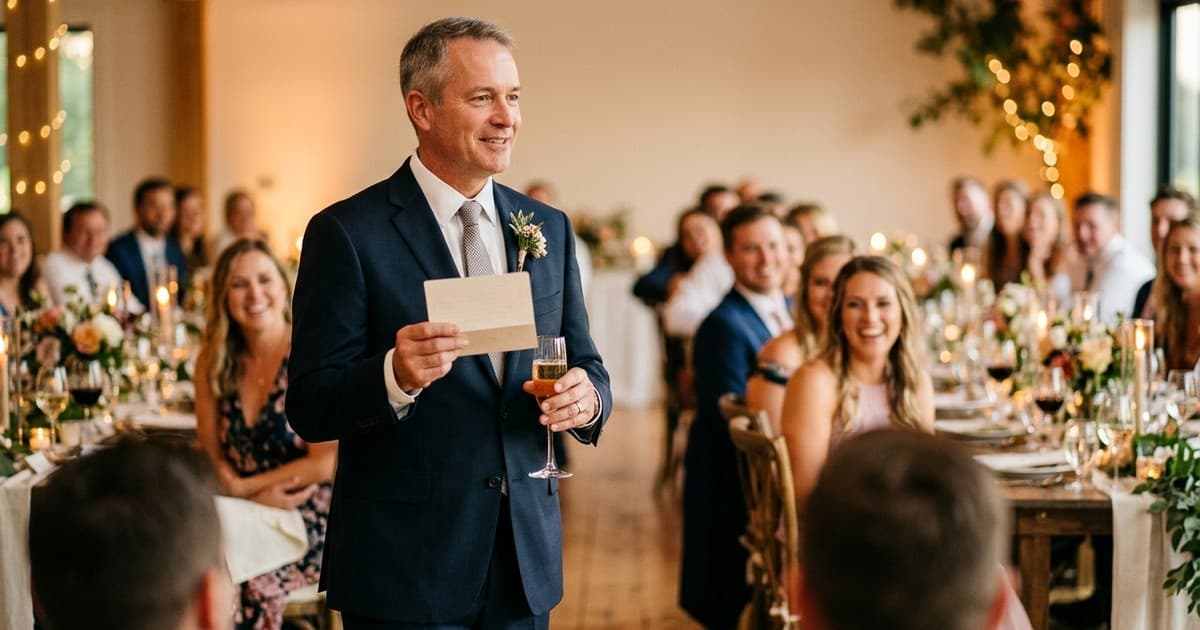
Reading word-for-word. Notes are fine. A printed speech that you read without looking up is not. People came to see your face when you say these things. Practice enough to look up at your daughter when you get to the parts that matter.
Forgetting the partner. Some fathers spend four minutes talking about their daughter and give her new spouse forty-five seconds of "and we're so happy to welcome him into the family." That's not a welcome, that's a footnote. Your daughter chose this person. That choice deserves more than a postscript.
Bringing up the wrong stories. Not everything funny that happened is funny to everyone. Stories about her teenage years, the ones that involve her parents being embarrassed or her being embarrassed: vet them. If she'd cringe, cut it.
Not practicing out loud. Something that reads perfectly on the page will sometimes feel wrong the moment you say it in a room. You'll only find that out by saying it out loud, multiple times, before the day.
A structure to work from
This isn't a template. It's a scaffold. The words have to be yours.
- Opening line: specific and unexpected (2-3 sentences)
- Childhood memory: one scene, told in detail (45-60 seconds)
- Who she became: qualities you've watched develop, named and illustrated (45-60 seconds)
- What you see in them together: what you've observed, what it tells you (30-45 seconds)
- Address to her directly: what you want for her life (30-45 seconds)
- Welcome to the partner: warm, specific, brief (20-30 seconds)
- The toast: one sentence, raise your glass
Total: roughly 3.5 to 4 minutes at normal speaking pace.
Practice it until you could give it without the paper. Then keep the paper anyway, just in case.
Keep reading:
- Father of the Bride Speech Tips: How to Say What You've Always Felt
- How to Write a Wedding Speech for Your Daughter
- Father of the Bride Speech Examples
This speech will be the one people remember. It deserves the same care she's put into every other part of this day.
SpokenVow interviews you the way a speechwriter would, drawing out the specific memories, the real observations, the voice that's yours and nobody else's. Then it crafts a complete draft you can refine until it's exactly right.