30 Wedding Speech Red Flags (Things That Will Make the Room Cringe)
The most common wedding speech mistakes, from the minor to the catastrophic. Avoid these and you're already ahead of 80% of speakers.
Part of the How to Write a Wedding Speech guide: structure, length, opening lines, and delivery.
You can learn a lot about what makes a great wedding speech by studying what makes a bad one. And bad wedding speeches share a surprising number of characteristics.
Not because people are bad at speaking. Most people are fine at speaking. The problem is structure, preparation, and a handful of specific habits that have become so common at weddings that people repeat them without realizing the room has seen every single one before.
Here are thirty of them. Avoid all thirty and you are already ahead of most of the room.
The classics (that somehow keep happening)
1. "For those who don't know me..." Nobody needs the disclaimer. If the room doesn't know you, they'll figure it out from context. If they do know you, you've wasted a sentence. Either way, starting with an apology for your own existence is not the energy you want.
2. "Webster's dictionary defines love as..." The dictionary definition of love is not surprising, relevant, or illuminating. It is what you reach for when you don't have anything real to say. It signals to the room that the speech is going to be generic.
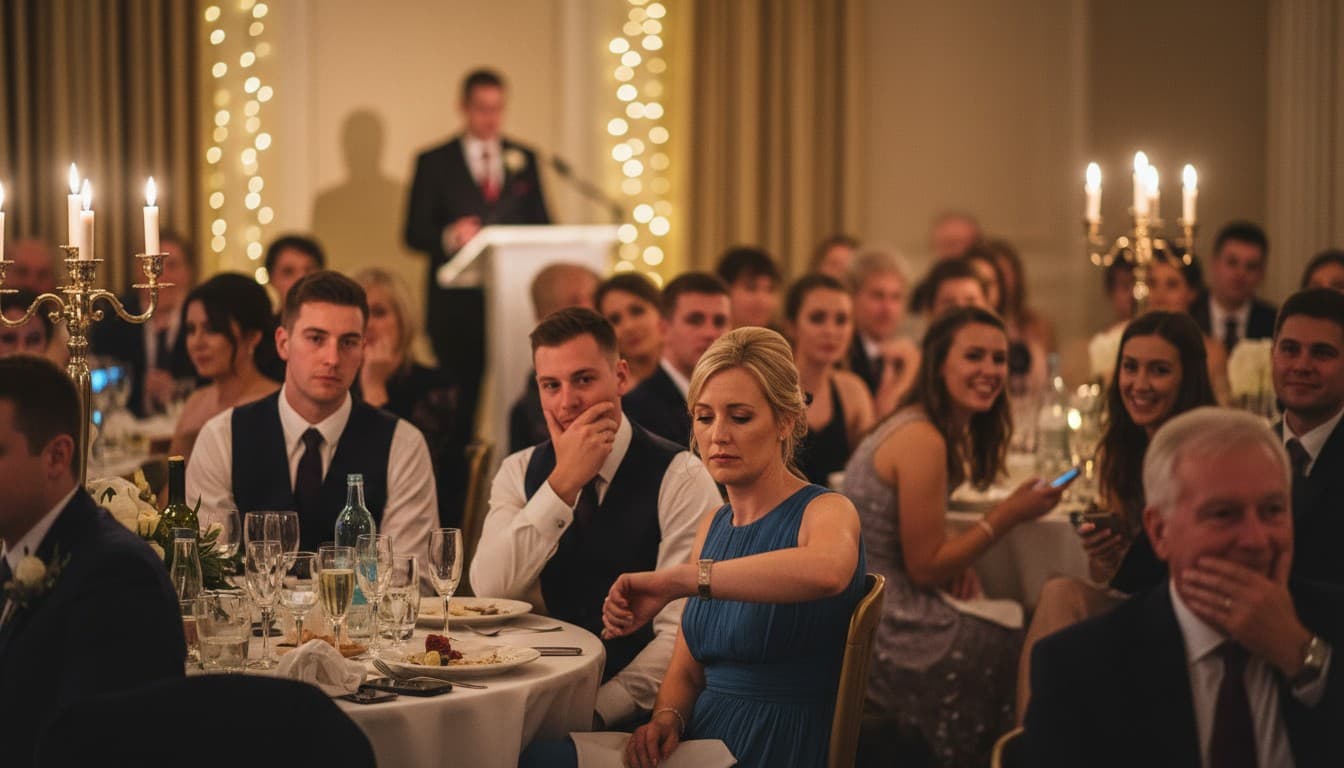
3. "I'll keep this short." (And then not.) If you say it, you've made a promise. Break that promise and the room will start glancing at their watches around minute four. If you want to keep it short, keep it short. Don't announce it.
4. "I'm not very good at public speaking." You've just told everyone in the room to lower their expectations and brace for awkwardness. Even if it's true, saying it doesn't help. The room wants to be on your side. Don't make them feel sorry for you before you've begun.
5. "I looked up some quotes about marriage..." A quote from Marcus Aurelius or a generic Instagram maxim about love is not a substitute for your actual thoughts. The couple didn't ask you to speak so you could read someone else's words. They asked you because you know them.
6. "I know the couple asked me not to say anything embarrassing, but..." You are about to say something embarrassing. The joke has been made approximately 40,000 times at weddings before this one. And whatever comes after "but" had better be extraordinary.
7. "Before I start, I just want to say thank you to..." Acknowledgments belong at the end, if at all. Starting with a roll call of names means the people who don't hear their name spend the first minute waiting for theirs, and everyone else checks out entirely.
8. "This is my first time giving a wedding speech..." Relevant information for no one. Don't explain your lack of experience. Demonstrate competence instead.
9. "I could stand up here all night talking about Jake..." Please don't. Nobody believes you mean it. And the implied promise that you could go on much longer is not reassuring.
10. The speech that is secretly a roast of yourself. You are the supporting actor. The speech that becomes about your own journey, your own feelings, your own growth is a different speech. The room wants to hear about the couple.

Structural problems
11. Going over seven minutes. Five minutes is a long wedding speech. Seven minutes is too long. Past seven minutes, the room is not listening, they are enduring. Cut the last thing you added. Then cut the next-to-last thing you added.
12. Having no ending. "And, um, yeah. So. Raise your glasses." The speech that trails off rather than lands is the speech people forget by the time they get to the buffet. Your ending is the only thing they will remember. Plan it first.
13. Reading word-for-word without looking up. Some notes are fine. Reading verbatim from your phone for five straight minutes without making eye contact with anyone is a choice the room will notice and remember. At minimum, look up for the key moments.
14. A toast without a toast. You raised your glass and then kept talking. Then looked at your notes. Then raised your glass again and wrapped up with something vague. The toast should be one clear sentence, a pause, and the clink. Know exactly what your toast sentence is before you stand up.
15. The speech that has no emotional arc. Funny throughout with no turn toward the heart feels like a roast that ran long. Emotional throughout with no lightness feels like a eulogy. The best speeches do both. If yours does only one, the room will feel the absence of the other.
16. Telling the couple's story instead of your story about the couple. You don't need to recap how they met, their first date, when they moved in together. The couple knows. The people who knew them well know. Focus on what you specifically saw and experienced. That is the story only you can tell.
17. The multi-act structure that keeps not ending. "And one more thing..." three times in a row. The speech that has multiple fake endings is frustrating even when every section is good. End once, clearly, and sit down.
18. Forgetting to actually toast the couple. It has happened. The speech ends, the speaker sits down, and someone has to quietly remind them to raise a glass. The toast is not optional. It is the whole point.
Content landmines
19. Mentioning an ex. There is no version of this that goes well. "He almost married someone else but..." is not a compliment to the bride. Even a "we're glad that didn't work out" is a shadow you are casting over a day that deserves none.
20. The roast that never turns to heart. Roasting is fine. Roasting without a turn at the end leaves the groom looking like the butt of a joke on his own wedding day. The room will laugh, and then feel slightly bad about laughing, and that is not the memory you want to leave.
21. Inside jokes that require three minutes of explanation. If you have to say "you had to be there," the story has already failed. Inside jokes work when the texture of the joke is universal even if the specifics are not. If you need to explain it, cut it.
22. Making the speech about yourself. "When I heard they were getting engaged, it made me think about my own relationship..." The couple and their guests are here to celebrate the couple. Your personal epiphanies belong in your journal.
23. The overly long medical or health story. "When he was in the hospital, and we thought it might be serious..." These stories can work when they are brief and there is a clear point about character. When they go into clinical detail and the room sits in uncomfortable silence for ninety seconds, they do not work.
24. Anything that hints at doubt about the marriage. "I wasn't sure about this at first, but..." "It took me some time to warm up to the idea..." Even if you've come around completely, planting the seed that you were ever uncertain is a gift nobody at a wedding wants to receive.
The delivery disasters
25. Getting too drunk before you speak. There is a version of this that is charming for about forty-five seconds, and a version that derails the entire reception. You know which one you are at risk of. Drink after.
26. Speaking directly into the microphone from two inches away. The result is distortion. The room hears every breath, every pop. Hold the mic four to six inches from your mouth, project slightly, and the room will hear you clearly. Bonus: you will look more confident.
27. Starting before the room is quiet. Beginning your speech while half the room is still finishing a conversation means your opening line, the most important sentence you will say, is lost. Wait. Make eye contact with the couple. Let the room come to you. Then begin.
28. The nervous laugh after every sentence. Nervousness is normal. Punctuating every observation with a self-conscious laugh signals to the room that you don't trust your own material. Slow down, pause instead of laughing, and let the words carry their own weight.
29. Forgetting to direct people to raise their glasses. The toast has no power if half the room still has their glass on the table. Be explicit: "Please raise your glasses." Then pause. Then deliver your toast sentence. Then raise yours.
30. Not practicing it out loud at least once. A speech that reads beautifully on a screen and has never been spoken aloud is full of surprises. Sentences that seemed short are long. The transition that felt smooth is abrupt. The story that seemed quick takes two minutes. Read it out loud. At least twice. Time it.
Keep reading:
- Terrified to Give a Wedding Speech? Read This First
- Wedding Speech Examples
- How to Shorten a Wedding Speech
The antidote to all of these? A speech that starts with your actual stories, not a template you filled in and not a ChatGPT output you slightly edited.
SpokenVow interviews you the way a professional speechwriter would: drawing out the specific details, the real moments, the voice that is uniquely yours. When the interview is over, you don't have a list of bullet points to assemble. You have three complete draft speeches ready to refine.